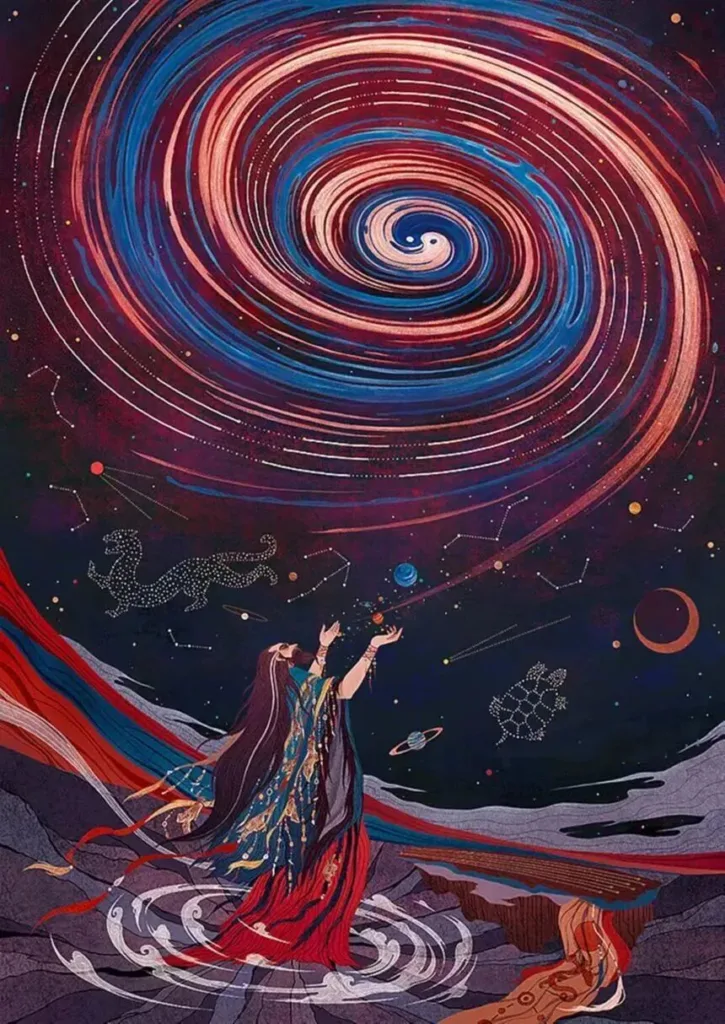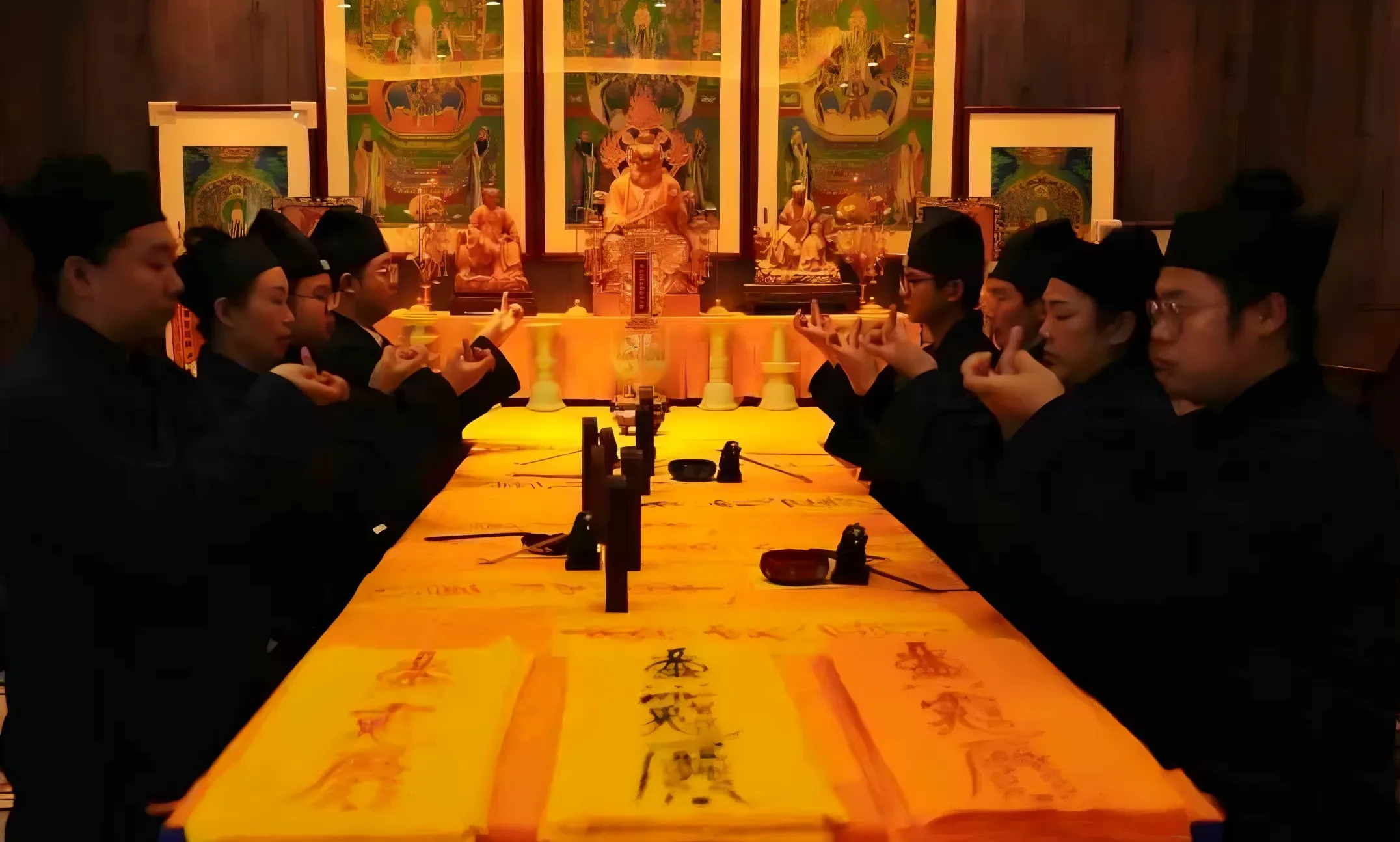



Before the cosmos, in the primordial chaos, there existed an undifferentiated entity, born before heaven and earth—this entity is the Dao. With a thunderous roar, chaos parted: the Dao gave birth to deities, the Dao gave birth to heaven and earth, the Dao gave birth to all things, like an infant crying out as it enters the world—a birth of greatness, a birth of joy.
The ever-generating Dao endows deities with divine power, grants heaven and earth the capacity to sustain, bestows upon all things vitality and prosperity, and gives humanity joy, delight, hope, brightness, and happiness—it imbues Taoism with its soul.
Life—a concept of profound significance in Taoism. All activities within Taoism revolve around it.
1. The Dao gives birth to deities.
Because there is life, the world has deities. The “Xuan Gang Lun” states: “The Dao is the thread of emptiness, the root of creation, the foundation of divinity, and the origin of heaven and earth.” So how does the Dao, as the foundation of divinity, transform into deities? The “Tai Shang Lao Jun Xu Wu Zi Ran Ben Qi Jing” says: “Before the Dao transformed into divinity, it was without beginning or order, without mind or intention, devoid of all desires, tranquil and unmoving.
Then it transformed into divine light. Divinity manifests its radiance outward, illuminating extensively, giving rise to mind and intention, from which various desires emerge, further disturbing the original truth.” At the same time, it emphasizes: “Divinity originates from the Dao. The Dao is pure and serene, possessing nothing, yet it transforms into divinity, giving rise to light, generating mind and intention, and producing all wisdom. Wisdom refers to the five desires and six emotions.”
Since the Dao gives birth to divinity, what are the specific details? The “Tai Shang Lao Jun Kai Tian Jing” states: The evolution of the universe by the Dao passes through several great epochs—Hong Yuan, Hun Yuan, Bai Cheng, Tai Chu, Tai Shi, and Tai Su.
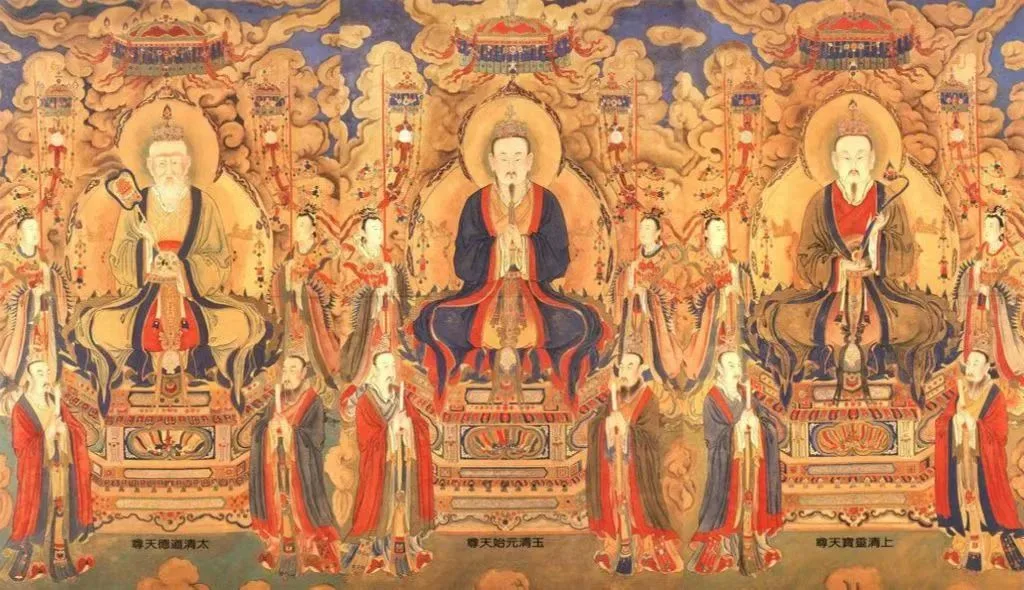
Before Tai Chu, the Dao had already evolved through three great epochs. The essence of the Dao, “the Celestial Venerable of the Primordial Beginning, the Celestial Venerable of the Numinous Treasure, and the Celestial Venerable of the Dao and Its Virtue,” began to transform and give birth to the universe and heaven and earth during the first epoch, the Hong Yuan epoch. Tai Chu marks the beginning of humanity, hence it is called Tai Chu! Before Tai Chu, heaven and earth were already distinct, the energies of the sun and the moon were already clear, and the primordial deities had already been transformed by the Dao. The Dao, of course, coexists with divinity! However, divinity is born from the Dao, and the Dao is the foundation of divinity. The Dao is not equal to divinity.
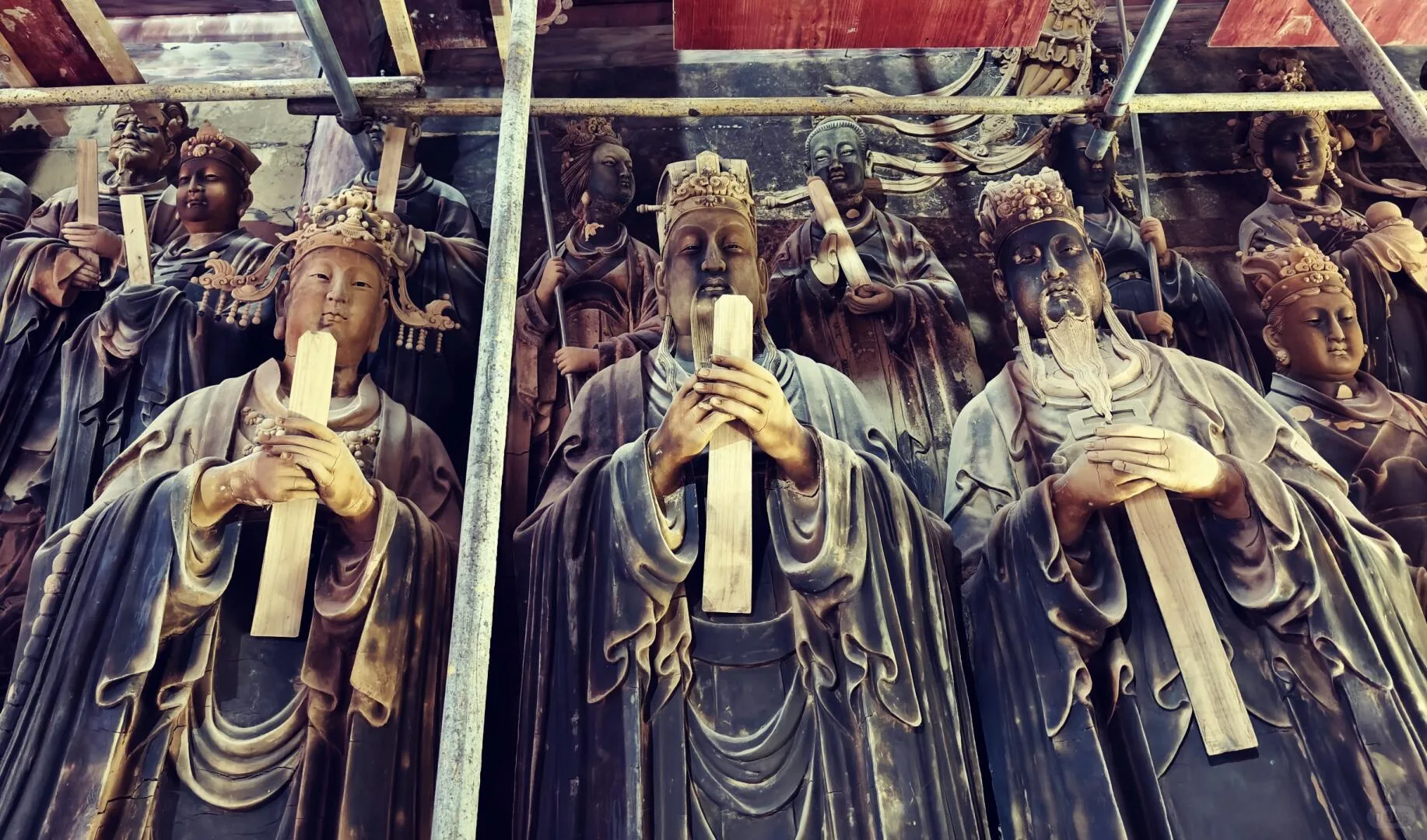
In essence, the Dao transforms into three primordial energies—Xuan, Yuan, and Shi—which then manifest as three supreme deities: the Celestial Venerable of the Primordial Beginning, the Celestial Venerable of the Numinous Treasure, and the Celestial Venerable of the Dao and Its Virtue. They are the embodiment of the Dao. The Three Pure Ones are the ancestors of all deities. The Three Pure Ones divide countless energies to nurture all beings. The Supreme Deity of Heaven, the Earth Deity, the King Father of the East, the Queen Mother of the West, the Three Officials, the God of Wealth, and all other deities are born from a single energy.
2. The Dao gives birth to immortals.
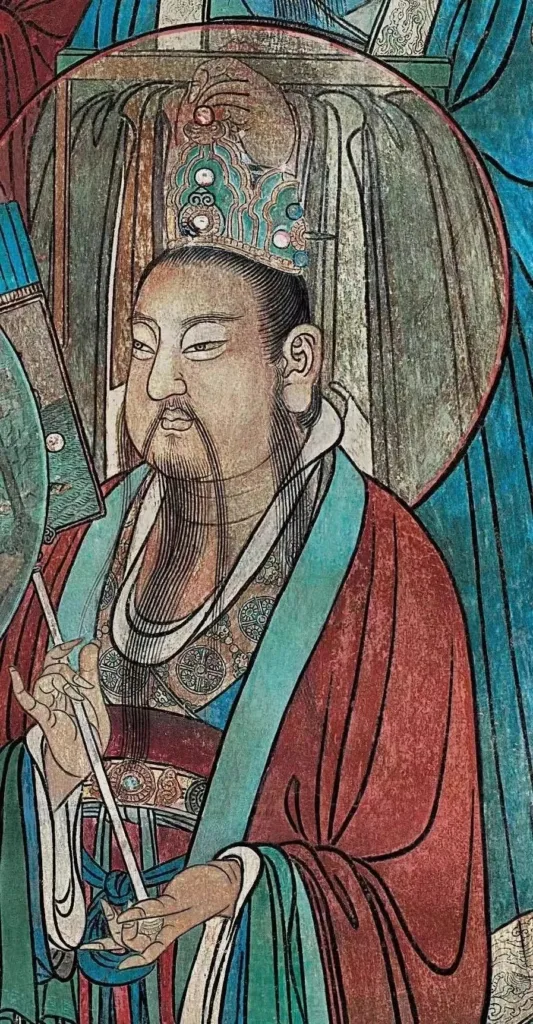
Because there is life, the world has immortals. In Taoism, “immortals” generally refer to those who have attained longevity and mastered the Dao through cultivation. The Book of Han: Records of Arts and Literature states: “Immortals are those who preserve the essence of life and wander beyond the mundane world.” Sometimes, immortals are also called “transcendents” or “perfected beings,” collectively referred to as “perfected immortals.” From a broad and Taoist theological perspective, “divine beings” are innate, existing before the separation of heaven and earth, and are called innate sages; whereas “immortals” are acquired, being individuals who have attained the Dao through cultivation in the secular world, known as acquired perfected immortals.
Zhuangzi categorized them into “perfected beings,” “supreme beings,” “divine beings,” and “immortals.” “Perfected beings” refer to those who have cultivated and attained the Dao; “supreme beings” are those who have comprehended the great Dao; “divine beings” are those who embody divine wonder and ultimate truth; and “immortals” are those who have attained the Dao through cultivation, possessing vast supernatural powers, unfathomable transformations, and eternal life.
Among these, whether divine beings or perfected beings, they are all inseparable from the “Dao.” Chapter 59 of the Tao Te Ching states: “Having the mother of the state, one can endure long. This is called the way of deep roots and firm foundations, the way of long life and lasting vision.” Thus, “attaining the Dao” is the prerequisite for “becoming an immortal,” which is why immortals possess the Dao.
The Biographies of Immortals describes the Taoist deity Dong Wang Gong (the King Father of the East) as “formed from the pure essence of the great Dao.” The Imperial Encyclopedia: Divine and Extraordinary Classics (Vol. 222) states that Xi Wang Mu (the Queen Mother of the West) was transformed from the “supreme energy of the western paradise,” “born with the ability to soar, presiding over the mysteries of the divine origin in the vast expanse, dividing the pure essence of the great Dao, and condensing energy into form.”
The Precious Declarations of the Three Officials praises the Great Emperors of the Three Officials as “crowning the Dao above all heavens, bestowing grace throughout the three realms.” The Precious Declarations of Universal Transformation describes the Celestial Worthy of Universal Transformation of Thunder as “the most exalted and Dao-filled.”
The Scripture of the Northern Celestial Worthy of True Martial Arts recounts that the Great Emperor of True Martial Arts was the prince of the Kingdom of Pure Joy, born with divine intelligence and the ability to perceive subtle truths. As he grew, he became exceptionally brave and dedicated solely to cultivation, vowing to eradicate all demons in the world and refusing to inherit the throne.
Later, he encountered the Primordial Lady of the Purple Void, who imparted to him the supreme secret of the Dao. He then journeyed across the Eastern Sea, where a celestial deity bestowed upon him a divine sword. He retreated to the Wudang Mountains for cultivation, and after 24 years, achieved perfection and ascended to immortality in broad daylight. This illustrates that both innate divine beings and acquired immortals possess the nature of the Dao, which is why they are called immortals.
Furthermore, longevity and enduring vision are defining traits of immortals. “Longevity and enduring vision” means achieving prolonged existence through cultivation. Its true meaning lies in physical longevity and spiritual immortality. Physical longevity refers to extending life beyond its natural span (Taoism believes the natural human lifespan is 120 years) through cultivation methods, pushing the limits of physical life—this is what is meant by longevity, though not eternal life.
Spiritual immortality refers to the genuine practice of cultivating both nature and life, achieving unity of nature and life, further realizing harmony between heaven and humanity, and unity of life and the Dao. By integrating one’s finite life into the infinite workings of the universe, one attains the permanence and eternity of life.
For thousands of years, Taoist practitioners have consistently regarded preserving essence and consolidating energy as the foremost requirement for becoming an immortal. They view essence, energy, and spirit as the three treasures of life, proposing: “Refine essence into energy, refine energy into spirit, refine spirit into emptiness, and refine emptiness into unity with the Dao.” Unity with the Dao enables longevity and immortality, transforming one into an immortal.

3. The Dao gives birth to all things.
Because there is life, the world has all things. The Dao “existed before heaven and earth.” It encompasses everything and contains all; it is the beginning of all things in the universe and the fundamental origin of the world. It is through the Dao that all things come into being—in other words, “the Dao gives birth to all things.”
The Tao Te Ching states: “The Dao gives birth to One; One gives birth to Two; Two gives birth to Three; Three gives birth to all things. All things carry Yin and embrace Yang, blending the vital energy to achieve harmony.” This means: the Dao generates the primordial混沌一气 (Chaotic Unity), which then divides into Yin and Yang—this is One giving birth to Two. The interaction of Yin and Yang produces the Three Realms—Heaven, Earth, and Humanity. Once the Three Realms are established, all things multiply—this is Three giving birth to all things.
All things embody Yin and Yang, carrying Yin while embracing Yang. All things find unity in the harmonizing vital energy (the Qi of the Dao). Thus, the formless Dao gives rise to the tangible world. Deities, as symbols of the formless Dao, are tangible—meaning the formless Dao likewise manifests as tangible deities. In this process, the Dao plays the decisive role.
Taoism believes that the Dao manifests as deities. In Taoism, Qi is the form of the Dao’s existence, the intermediary between different levels of reality, the “substance” that constitutes tangible things, and the universal connector that facilitates resonance and interaction among Heaven, Earth, and Humanity.
In Taoist cultivation, Qi is the intermediate layer between form and spirit. It connects the innate and the acquired, the central nervous system and the autonomic nervous system in humans, serving as the bridge from Daoist techniques to immortal practices. In summary, Taoism holds that Qi transforms into form, and form transforms into life. The entire universe is permeated by Qi—Qi is within humans, and humans are within Qi. All things depend on Qi for existence. The cycles of human life, as well as fortune and misfortune, are all governed by Qi. Within the human body, Qi connects both form and spirit. Thus, ensuring the smooth flow of Qi cultivates both the body and the spirit.
This Qi is sometimes also referred to as the Dao, originating from Laozi’s concept: “The Dao gives birth to One, One gives birth to Two, Two gives birth to Three, Three gives birth to all things.” The Taiping Jing elaborates on this: “All things originate from Primordial Qi. Heaven, earth, and all things are born from it.”
Primordial Qi is vague and natural, condensing to form Heaven, named Tian Yi (Heaven One). It then divides to generate Yin and form Earth, named Di Er (Earth Two). The interaction of Heaven and Earth, Yin and Yang, gives birth to Humanity, named San (Three). These three together nurture and sustain all things. The Qi of Heaven and Earth, derived from Primordial Qi, possesses intention and disposition. Yang Qi “favors life,” while Yin Qi “favors destruction.” Their union brings about the transformation and birth of all things. Primordial Qi surpasses the Heavenly Dao.
Later, the Tang Dynasty Taoist Wu Yun, in his Xuan Gang Lun, stated: “The Dao is the True One. Before the Great Void, there was silent emptiness—until the utmost essence stirred and generated the True One. The True One activates the spirit, and Primordial Qi naturally transforms. Primordial Qi is the existence within non-existence, the non-existence within existence—vast beyond measure, subtle beyond detection. It gathers gradually,混沌 without boundaries, the beginning of all manifestations, with signs emerging here. The clear, pure, and bright Qi ascends to form Heaven; the turbid, stagnant, and dense Qi accumulates to form Earth.”
Du Guangting also said: “The Dao is Qi, also called essence or Primordial Qi. The Dao is fundamentally formless, beyond naming—it is the Qi of emptiness, the origin of chaos, the ancestor of Heaven and Earth. It can exist and not exist, enveloping all of Heaven and Earth.”
Chen Jingyuan, in his commentary on the Tao Te Ching, said: “Emptiness gives birth to nature, nature gives birth to the Dao, the Dao gives birth to One, and One transforms into things. The Dao is the emptiness within emptiness, the non-existence within non-existence, the nature within nature—混沌 and vast, profound and silent, beyond description. Yet, through movement and transformation, it is called混沌, which is One.混沌 Qi disperses and generates the clear, turbid, and harmonious energies, forming Heaven, Earth, and Humanity—the Three Realms. Once the Three Realms are established, all things transform and multiply.”
Zhang Boduan, in his Wuzhen Pian, used the theory of cosmic generation as the foundation for his cultivation teachings, elaborating thoroughly on the relationship between the Dao and all things: “The Dao, from emptiness, generates One; from One, Yin and Yang are produced; Yin and Yang combine to form the Three Entities; the Three Entities repeatedly generate the flourishing of all things.” In this way, the formless Dao and the tangible world are intimately connected.
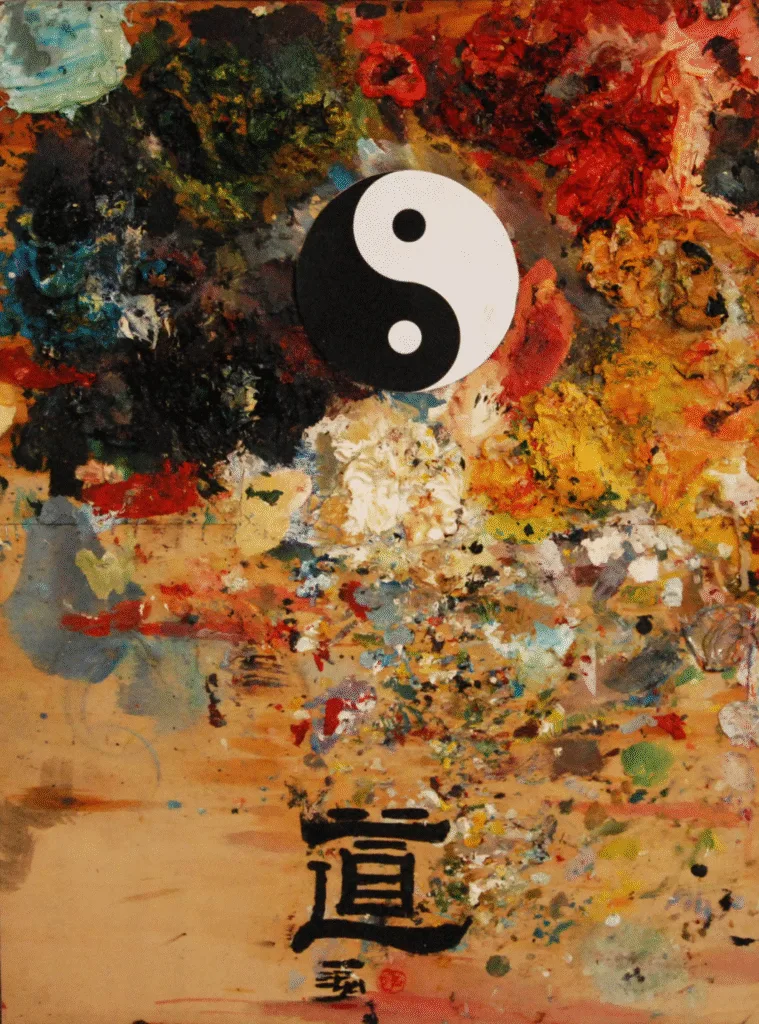
4. The Dao gives birth to life.
Because there is life, all things are vibrant. After the Dao gave birth to all things, they strive to emulate the Dao, diligently practicing its principles for survival and development.
The universe follows the Dao, with galaxies and celestial bodies operating and evolving according to certain laws. These laws are known as dark matter and dark energy.
Microorganisms follow the Dao, growing, reproducing, metabolizing, undergoing genetic variation, ecological distribution, and evolutionary classification in an orderly manner within environments invisible to the naked eye. This order is referred to as species.
Living beings follow the Dao, occurring, developing, evolving, and perishing in accordance with natural patterns. These patterns are known as genes.
Plants follow the Dao, propagating and growing orderly under sunlight, in soil, and water. This order is called photosynthesis.
Animals follow the Dao, reproducing and perpetuating their kind in accordance with the rules of nature. These rules are suited for survival.
Humans follow the Dao, perpetuating their lineage and reproducing in harmony with nature. This harmony is known as essence and energy.
Humans, as the most spiritual beings in the universe, can comprehend astronomy above and geography below by following the Dao. They can achieve resonance between heaven and humanity, unite with the cosmos, become impervious to water and fire, traverse heaven and earth, and move between the realms of the living and the dead. They can attain physical and mental well-being, longevity, and enduring vision. Therefore, for humans to truly live, they must value life. Cherishing life and rejoicing in it are measures of one’s alignment with the Dao and fundamental principles of Taoist teachings. The high regard and affirmation of the value of life are unwavering traditions in Taoist guidance for humanity.
The first classic in the Taoist Canon, the Du Ren Jing, emphasizes at the outset: “The Way of Immortals values life.” The early Taoist scripture Taiping Jing (Volume 114) states: “Life must be cherished above all, for life is the foremost priority.” This idea was further developed in the Laozi Xiang’er Zhu (Chapter 25), which states: “Life is a manifestation of the Dao.” The San Tian Nei Jie Jing from the Liu Song period declares: “A dead king is inferior to a living mouse.” The Taishang Laojun Neiguan Jing, from the Sui and Tang dynasties, summarizes the Taoist ideal for humanity as the “unity of life and the Dao.”
In fact, since its inception, Taoism in China has been a religion that values the reality of human life. Thus, cherishing and honoring life is a fundamental characteristic of Taoism. Taoism holds that all things in heaven and earth are born of the Dao: “The Dao gives birth to One, One gives birth to Two, Two gives birth to Three, and Three gives birth to all things.” Among all things, human life is the most precious. “The greatness of heaven and earth lies in life,” and “life” and the “Dao” are one.
Various Taoist classics invariably emphasize the ideas of “valuing life,” “cherishing life,” and “nurturing life” as core tenets. In Taoism, life is considered most precious, and it is hoped that everyone can live out their natural lifespan, even achieving longevity and enduring vision. The Wu Fu Jing states: “Heaven gives birth to all things, but humans are the most noble.” The Dongxuan Lingbao Zhai Shuo Guang Zhu Jie Fa Deng Zhu Yuan Yi also says: “Among all things, humans are the most noble, and life is humanity’s treasure.” Baopuzi remarks: “Life is to be cherished, death is to be feared.” The Miaozhen Jing states: “No virtue is greater than preserving life.”
This emphasis on cherishing and honoring life is the most distinctive feature of Taoism compared to other religions, reflecting its profound care for human life. It not only influences people’s attitudes toward life and existence but also promotes Taoism’s recognition of the value of all living beings.
From the spirit of “universal compassion and love,” Taoism urges people to “be compassionate toward all things,” treating every life in the universe with a benevolent heart, extending love to insects, plants, trees, birds, and animals, and refraining from harming any life unjustly. Its precepts include: do not kill any living being; do not burn fields, forests, or mountains; do not trample on livestock; do not trap birds or animals, and so on.
The Taishang Dongyuan Shenzhou Jing says: “The nature of the Dao is inherently pure, rescuing all people, universally aiding all living beings, with the Supreme One bestowing great compassion.” Taoism’s emphasis on human life and existence demonstrates its utmost passion for caring about life. The most important aspect of valuing life is to prioritize human existence and well-being.
Human life and well-being encompass two aspects: first, the material conditions and environment for survival, i.e., material life; second, spiritual life. Material life and the environment address the basic needs of physiological existence, while spiritual life addresses psychological and spiritual pursuits. In material life, Taoism teaches people to reduce selfish desires, be indifferent to fame and wealth, and preserve the primordial truth of life. It also guides people to strive for the creation of a peaceful and harmonious living environment.
In spiritual life, Taoism teaches people to pursue a state of unity with the Dao, free and unhindered. Although life may bring various hardships, as long as one adheres to the “eternal Dao” as the great purpose, without distinguishing between the roc’s journey of ten thousand miles and the quail’s flight of a few yards, as long as the mind is free, the spirit tranquil, and the focus unified, all hardships are merely dust on the body—a simple shake is enough to remove them, leaving one refreshed and clear-minded.
Taoism believes that “my life lies with me, not with heaven or earth.” Every person possesses the nature of the Dao. Through cultivation and practice, one can attain the Dao through life, achieve immortality through the Dao, and attain truth through immortality, ultimately reaching a state where life and the Dao are united, form and spirit are wondrously aligned, and one becomes one with the Dao.
However, all practices of cherishing and honoring life must be grounded in “true actions” of engaging with the world and benefiting society, starting with personal conduct and self-cultivation. For Taoism, the pursuit of immortality through cultivation and the promotion of health through nurturing life are consistent: cultivation is nurturing life, and nurturing life is cultivation.
Taoism holds that cultivation involves understanding the transformations of heaven and earth, applying the workings of Yin and Yang, comprehending the subtleties of virtue and the Dao, and attaining the truth of life. To achieve this, one must eliminate greed and desires, return to simplicity and purity, calm the mind, and harmonize with tranquility. Remain still and act in accordance with nature; empty the mind and merge with the cosmos without leaving traces; illuminate without intent, embracing all transformations without attachment. Do not allow likes, dislikes, or judgments to harm life internally or injure the body externally. Ultimately, achieve the unity of body and mind, the wondrous alignment of form and spirit, and the free, transcendent state of immortality.
In summary, the ever-generating Dao gives birth to deities, immortals, heaven, earth, all things, and humanity. Therefore, humans must cherish life and nurture it, focusing not only on personal physical and mental health but also on universally aiding all beings, enabling every member of society to live a healthy and joyful life, worthy of the happiness bestowed upon humanity by the great Dao.